Most golfers believe improvement only happens at the driving range. That belief slows progress. The truth is different. With structured home drills, mirror feedback, and controlled repetition, you can build mechanics faster indoors than outdoors.
The range often hides swing mistakes because ball flight distracts from movement quality. At home, you remove that distraction. You train body motion directly. This creates cleaner sequencing, better consistency, and stronger contact when you return to the course.
This guide explains exactly how to improve your golf swing at home using practical drills, alignment techniques, and simple tools. No expensive simulator required.
Can You Really Improve Your Golf Swing at Home?
Snippet Answer: You can improve your golf swing at home by practicing posture, grip, alignment, takeaway control, rotation sequencing, tempo drills, and impact positioning. Structured mirror work and slow-motion rehearsals build muscle memory faster than range practice because they remove ball-flight distractions and reinforce correct movement patterns.
Answer Block: Yes. Home golf practice improves swing mechanics by isolating movement patterns like posture, grip pressure, sequencing, and rotation. Without ball distraction, you build correct habits faster. Consistent daily rehearsals indoors create reliable muscle memory that transfers directly to stronger contact and straighter shots on the course.
Most swing errors come from body mechanics, not ball interaction. Practicing indoors lets you correct posture, shoulder turn, and hip movement precisely.
Range sessions often reinforce mistakes because golfers chase distance instead of structure. Home practice shifts attention toward movement efficiency.
Professional players rehearse indoors daily using slow-motion repetition. They refine sequencing before hitting balls.
- Mirror practice improves posture awareness
- Slow swings improve sequencing
- Grip checks prevent clubface errors
- Tempo drills stabilize rhythm
Consistency beats intensity. Ten minutes daily indoors produces stronger results than one weekly range session.
What Setup Fundamentals Should You Practice Indoors First?
Answer Block: Practice posture, grip neutrality, ball position simulation, and alignment using mirrors or floor reference lines. Setup controls swing direction and contact quality. Improving setup indoors reduces slicing, topping, and inconsistent strike patterns before you even swing a club outdoors.
Setup determines swing outcome before movement begins. Most amateur golfers lose accuracy because their address position is unstable.
Start with posture. Bend from hips, not spine. Maintain neutral back alignment.
Next, confirm grip pressure. A relaxed grip allows wrist hinge naturally. Excess tension reduces clubhead speed.
Then check shoulder alignment. Shoulders must stay parallel to the target line.
- Place an alignment stick on the floor
- Stand parallel to it
- Check shoulder direction in mirror
- Confirm neutral grip position
Repeat this setup routine daily. Reliable setup reduces swing compensation later.
How Can Mirror Practice Fix Swing Mechanics Faster?
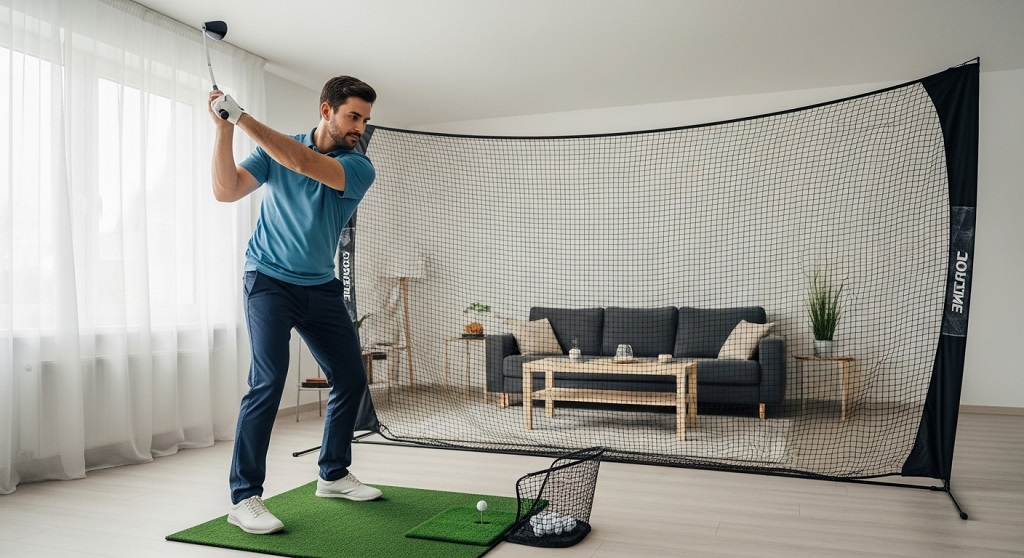
Answer Block: Mirror practice accelerates swing correction by providing instant visual feedback on posture, takeaway path, shoulder turn, and hip rotation. Seeing movement in real time prevents incorrect repetition and helps golfers build efficient mechanics without relying on ball flight as feedback.
Visual feedback changes how quickly the brain learns movement patterns. Mirrors remove guessing.
Position a full-length mirror beside your swing path. Practice slow takeaway motion first.
Watch for these checkpoints:
- Club stays outside hands during takeaway
- Lead shoulder rotates under chin
- Trail hip rotates without sliding
- Spine angle remains stable
Slow swings should take five seconds back and five seconds down.
This teaches sequencing rather than speed.
After one week of mirror work, most golfers see improved swing plane consistency.
Which Simple Tools Help Improve Swing Practice at Home?
Answer Block: Alignment sticks, mirrors, impact bags, resistance bands, and smartphone video recording are the most effective home swing tools. These tools improve alignment accuracy, sequencing strength, impact position awareness, and tempo control without requiring a simulator or driving range access.
You do not need expensive equipment to train effectively.
| Tool | Purpose | Skill Improved |
|---|---|---|
| Alignment Stick | Target reference | Swing direction |
| Mirror | Visual feedback | Posture control |
| Impact Bag | Contact training | Strike compression |
| Resistance Band | Rotation strength | Sequencing speed |
| Phone Camera | Motion review | Swing plane accuracy |
These tools replicate coaching feedback at home.
Even professional academies rely on the same fundamentals.
How Do Slow-Motion Swings Improve Contact Consistency?
Answer Block: Slow-motion swings improve contact by strengthening sequencing between hips, torso, arms, and clubhead. Practicing swings at reduced speed allows golfers to maintain posture, control clubface angle, and prevent early extension, resulting in more centered impact during full-speed swings later.
Speed hides mistakes. Slow motion exposes them.
Begin with half-speed swings. Focus only on rotation order.
The correct sequence is:
- Lower body rotates first
- Torso follows
- Arms drop naturally
- Club releases last
Practicing this sequence daily improves ball compression dramatically.
Many golfers swing too fast too early. That creates slicing.
Slow swings teach timing precision.
What Indoor Drills Build Better Rotation and Power?
Answer Block: Rotation drills using resistance bands, chair support turns, and step-through swings improve hip mobility and torso sequencing. These exercises increase swing efficiency by training the body to generate power from the ground instead of relying only on arm speed.
Power comes from rotation, not arms.
Try the chair rotation drill first. Hold a chair back and rotate shoulders fully.
This improves flexibility safely.
Next, resistance band torso turns strengthen swing muscles.
- Attach band to stable object
- Rotate slowly against resistance
- Return with control
- Repeat ten times each side
Step-through swings simulate weight transfer.
These drills improve distance without hitting balls.
How Can You Practice Impact Position Without Hitting Balls?
Answer Block: Practicing impact position using an impact bag or paused swing checkpoints trains forward shaft lean, weight shift, and square clubface control. Repeating correct impact alignment indoors improves compression and reduces fat or thin shots during real play.
Impact determines shot quality more than backswing style.
Use an impact bag or pillow substitute.
Focus on these checkpoints:
- Hands ahead of clubhead
- Lead hip rotated open
- Weight shifted forward
- Chest facing target
Hold the impact position for three seconds.
This strengthens muscle memory for solid contact.
Practicing impact without hitting balls removes fear of mishits.
How Often Should You Practice at Home for Real Improvement?
Answer Block: Practicing at home for 10–20 minutes daily produces faster swing improvement than occasional range sessions. Short, focused repetition builds consistent movement patterns, strengthens sequencing memory, and prevents regression between outdoor practice sessions.
Consistency beats duration.
Follow this weekly structure:
- Day 1: Setup rehearsal
- Day 2: Mirror takeaway drills
- Day 3: Rotation exercises
- Day 4: Impact training
- Day 5: Tempo swings
- Day 6: Video review
- Day 7: Recovery mobility work
This schedule builds complete swing stability.
Within four weeks, most golfers notice improved strike consistency.
Conclusion: The Fastest Way to Build a Reliable Golf Swing at Home
Improving your golf swing does not require a driving range. It requires structure.
When you train posture, sequencing, rotation, and impact indoors, you remove distractions that slow learning outdoors. This makes every repetition count.
Mirror feedback corrects alignment mistakes early. Resistance drills strengthen rotation. Impact rehearsals improve compression. Slow-motion swings refine sequencing.
Combined together, these methods create measurable progress in just weeks.
The key is consistency. Ten focused minutes daily builds more improvement than random long sessions.
Start today with posture checks and takeaway drills. Add rotation work tomorrow. Within a month, your contact quality and confidence will improve noticeably.
Commit to structured home practice now and your next round will feel different.
Frequently Asked Questions
Can beginners improve their golf swing without hitting balls?
Yes. Beginners benefit significantly from practicing posture, grip, and sequencing indoors because these fundamentals determine swing consistency before ball contact becomes relevant.
Is mirror practice enough to fix a slice?
Mirror practice helps correct takeaway path, shoulder alignment, and clubface control, which are the most common causes of slicing for amateur golfers.
How long does it take to see improvement?
Most golfers notice better contact within two to four weeks of consistent daily indoor practice focused on setup, rotation, and impact positioning.
Do I need expensive swing trainers?
No. Alignment sticks, mirrors, and resistance bands provide enough feedback to improve swing mechanics effectively at home.
Can indoor practice increase swing speed?
Yes. Rotation drills and sequencing exercises improve kinetic chain efficiency, which increases clubhead speed over time.
How many swings should I practice each day?
Practicing 30 to 50 slow-motion swings daily builds reliable muscle memory without causing fatigue or reinforcing incorrect mechanics.
Should I record my swing during home practice?
Yes. Recording your swing helps identify posture errors, sequencing issues, and alignment mistakes that are difficult to detect without visual feedback.
Read More Also: Simple Golf Drills for New Golfers to Practice at Home
Learn More: Best Public Golf Courses in the USA for Budget Golfers